Saturday, October 25, 2008

Huntington Creek with Jake

Inspired by my Bardi friends' love for fishing, I dug my fly fishing gear out of storage and started planning a fishing trip. Jake, a friend from grad school, voiced some interest and so we set out early Thursday morning for a day of fly-fishing near Huntington Utah.

The Huntington's a small, friendly stream this time of year with lots of riffles, flats and pocketwater.

From Fishing!


It's full of Brown trout, which are easily the most rewarding trout to catch, in my opinion. Not only do they usually fight harder than Cutthroat, but they're usually pretty hard to fool and are especially beautiful around spawning season (mid to late October).

From Fishing!


I managed to catch and quickly release quite a few fish during the course of the day. I tried to stay out of their way as much as possible since it seemed like they were trying to spawn.

From Fishing!


All of the fish I caught were Brownies in the 8-14" range. Not the biggest fish in Utah, but easily some of the most photogenic.

From Fishing!


From Fishing!


Add near-perfect weather and an enthusiastic new fishing partner to all the fishing success and you get the best day of fishing I've experienced in Utah so far!

Tuesday, October 14, 2008

Iwayn

After my trip up to Ngamakoon with Steve, it stayed pretty quiet. We were half-expecting a visit from the Ngama mob sometime before my departure on the 21st of September, but since such things are oft-promised and rarely done Steve, Deb, and I weren't too worried about getting Djugarargyn ready for the visit. Instead, Deb went to her job at Djarindjin as usual while Steve and I worked on a few projects around the block.

On the 16th, Deb came back from Djarindjin with some interesting news: Trevor Sampi was curious if I'd like to come out on the boats with the Rangers. The next day, I was in Djarindjin with Deb, waiting for the pickup. Soon enough, we were in the boats on our way over to Iwayn (Sunday Island).

From Oz Fieldtrip 2008


The Rangers had a mapping exercise to complete on the island, but it wasn't so serious that we couldn't do a little traditional fishing in the mangroves beforehand!

From Oz Fieldtrip 2008


Trevor, Louise the instructor and I wandered down to an old settlement to map invasive species, while Dwayne minded the boat.

From Oz Fieldtrip 2008


From Oz Fieldtrip 2008


After finishing up GPS instruction, we rode over to the beach where we'd be sleeping over night and set up camp.

From Oz Fieldtrip 2008


Then we went fishing for golden-lined spinefoot. A Bardi favorite. Trevor and Dwayne really cleaned up with the spearguns. Louise and I had a much harder time of it.

From Oz Fieldtrip 2008


The camp was very, very nice except for the sandflies and most people agreed that if you know what you're doing, living on a desert island really isn't that bad. In the morning, as we waited for the tide to come back into harbor, Mark Shadforth took Louise and me on an ant-collecting mission.

From Oz Fieldtrip 2008


Then Nathan Sampi showed us how to harvest the meat from giant clams.

From Oz Fieldtrip 2008


I soaked up the scenery on the ride home and it's a good thing too, as this proved to be the last adventure of my first season with the Bardi. I left Broome four days later and returned to America on the 24th to deal with culture shock and plan my next trip.

Wednesday, October 8, 2008

More Ngamakoon

Steve gladly drove me up to Ngamakoon at Trevor's suggestion. Steve seemed nearly as excited as I did about the invitation. He obviously had great respect for Uncle Paul Sampi. Uncle Paul (or Ngama Paul, as he's called by unrelated people within the community) is about 76 years old and one of the most powerful people around. He is truly a repository of history and culture. Much like his son Trevor, Uncle Paul harbors not a trace of distrust or malice for outsiders. Also like his son, Paul Sampi is warm, friendly, and an expert at putting new acquiantances at ease. Unlike Trevor, Paul enjoys talking.

Within a few minutes of my arrival, Uncle Paul had me convinced that we were great friends. He told me how much he loves visiting America - especially San Francisco. He spoke tenderly of past researchers who'd worked in the community and expressed his delight at my interest in doing research among the Bardi. He asked about my specific research interests and my motivation. He suggested possible collaborators and asked if I had any questions he could answer personally. I immediately blurted out how curious I was about the process of making a boomerang. While I worried about secret-sacred knowledge and how reckless I'd been by shouting out a query without considering how sensitive the topic might be, Uncle Paul's face lit up. He whispered something to Trevor, who walked back to a shed and came back with a couple boomerangs. Uncle Paul held one up and said, "you mean these?"

From Oz Fieldtrip 2008


He then proceed to tell me all about not only the process of making boomerangs, but how one fights with them. "You need good vision to fight with boomerangs," he said before launching into stories of taking on 6 opponents single-handedly. Once again, I was shocked by how open and generous Bardi men were. He then proceeded to retrieve a number of incredible tools.

Stone axes:
From Oz Fieldtrip 2008


Kimberley points:
From Oz Fieldtrip 2008


He also asked Trevor to haul out one of his paintings. Trevor's a really good, completely untrained artist.
From Oz Fieldtrip 2008


I was in taken aback by how unguarded these men were. Reading and hearing about other anthropologists' misadventures among indigenous peoples, I had expected a cold reception full of pointed questions and sideways glances. I consistently received the opposite. I really and truly did not want to leave when Steve intimated that we should say goodbye and get back to the block. I'd be back soon, however...

Saturday, October 4, 2008

Djarindjin

The day after we finished the compost toilet's footings, Steve and I drove up to Djarindjin. Unlike Djugarargyn and Ngamakoon, which are called "outstations" or "blocks," Djarindjin is a "community." This means that people other than extended family members live in the same area. There is a council. There are ~300 citizens. There are also many more unseemly social issues.

It was in Djarindjin that I first met Trevor Sampi, Kevin George, and his son Dwayne. Steve had invited them over for lunch and suggested that I might like to hang out with them for a while. Once they'd finished lunch and a short interrogation of my intentions as a researcher, they invited me to ride along in their truck as a temporary member of the Bardi-Jawi Rangers. The Indigenous Rangers Program is funded by the federal government with the intentions of a) providing economic opportunities for young Aboriginal Australians who make the effort to stay in their home communities and b) encouraging active oversight of the harvest and use of resources on land held by the community.

To this end, we drove out to a few isolated blocks, checking up on residents, letting them know what was going on throughout the Dampier, asking what was going on there with the flora and fauna, and generally "looking out for country." Kevin George, the head ranger, repeatedly stated that this was the program's real utility. Since no one else could travel so widely and freely across the landscape, the rangers felt a certain level of responsibility for the entirety of Bardi and Jawi traditional lands.

I also met Mark Shadforth on this trip. Mark proved to be an uncompromisingly honest, open, and eager resource when it came to recounting the thoughts young men have about either staying home or making money somewhere else. But these conversations were still in the future. As was my second visit up to Ngamakoon. After we returned to Djarindjin, Trevor invited me to meet his father, Uncle Paul...

More Djugarargyn

Deb arrived at Djugarargyn later that day. She'd just gotten back from a trip down to Perth where their daughter had received medical treatment. Deb and I got on just as readily as Steve and I had. I looked forward to following along on the bushwalks scheduled for Sunday and Monday.

Sure enough, Deb's knowledge of the local flora and fauna was impressive. She pointed out a number of important plants, including the Pandanus tree:
From Oz Fieldtrip 2008


She also introduced me to the Bardi calendar. The calendar is an important set of guidelines that helps Bardi determine when to harvest which resources. The longer I stayed on the Dampier, the larger and more inclusive the calendar became. Deb wove different threads into her bush walks. The second seemed to build upon the first. If she'd scheduled more, I definitely would have kept tagging along!

Instead, she returned to Perth and I ended up helping Steve around the "block." We undertook a number of projects during my time at Djugarargyn, including: digging and cementing footings for the bio-friendly composting toilet, rerouting some kitchen plumbing, converting waste vegetable oil to biodiesel, and recycling parts from two old box trailers to make a new one.

From Oz Fieldtrip 2008


In between our projects, we took trips to Lombadina, Djarindjin, and Ngamakoon.

Thursday, October 2, 2008

Djugarargyn

The days following Ngamakoon were possibly the most frustrating of the entire trip. I spent large chunks of time on the beach recovering from an illness that manifested itself just as I arrived at Kooljaman. It seemed like Broome north. In addition, I was vainly trying to set up a fishing trip with Eddie and his uncle Bruce, while calling Steve Nicholls every day in an effort to get in touch with the Djugarargyn mob (of which he was the male half) who had originally agreed to host me. I spent two long days in limbo.

On the fifth, I went to the office to see if I had any messages (Eddie? Steve?) as I'd done every morning since Ngamakoon. Steve had called and said he'd be around. I rang him and we both commented on how unfortunate it was that I didn't have my own truck and he was fresh out of fuel. When we hung up, it looked like I'd be going home without meeting Steve or Deb. Later, as I was walking down to the beach for the sunset, a guy from Melbourne who I'd spoken to briefly a couple days earlier offered to give me a ride back to Broome. It would be one day earlier than I planned on leaving, but I'd save $100. I told him I'd have to think about it.

From Oz Fieldtrip 2008


I called Steve after the sunset. He agreed to host me. Gary agreed to drop me off at Djugaragyn the next morning. It was all set and I couldn't believe it. After more than 3 weeks of tedium, I was finally going to get a chance to make inroads!

I could barely contain my excitement as Gary, his wife Angie, and I trounced along the road to Djugarargyn. A shirtless Steve Nicholls greeted us at the truck. I knew things were going to go very smoothly. Steve had a relaxed sense of humor and a friendly disposition. He showed me around Djugaragyn after Gary and Angie pulled away.

First, the kitchen and front yard.
From Oz Fieldtrip 2008


Next, the black cockatoos.
From Oz Fieldtrip 2008


Finally, the country.
From Oz Fieldtrip 2008


From Oz Fieldtrip 2008

Tuesday, September 30, 2008

Ngamakoon

Eddie picked me up at Kooljaman around 8am on Wednesday, the 3rd. Eddie James is large man and more than a little imposing. In contrast to his physical presence and like nearly every Bardi man I met on my trip, Eddie proved very accommodating and patient. Gentle even.

After a jouncing trip over the pindan, we arrived at Ngamakoon where a small family from New Zealand was waiting. Annette, Eddie, the four Kiwis, Eddie's nephew Waylan and I hopped into an SUV and tooled off in the direction of the mud flat where we hoped to find a crab or two. The sucking mud felt good on my bare feet, but the mangrove roots didn't! There were schools of mud-skippers on the flate and small fish circled our ankles in the brackish pools. Crabs were more elusive.

Soon enough though, we came to a sharply cut bank on the edge of a mangrove stand. There were large holes in the mud where, according to Eddie, the mud crabs come to mate. Soon enough, Eddie started pushing a long steel rod into the holes. The rod had been bent into a hook on both ends. The idea is to stick the rod in, get a crab to clamp a claw onto it, then pull the crab out by its claw. Sometimes the crabs drop their claws in an effort to escape (claws are their heaviest bodyparts and slow the creatures down ). This is when the hooked ends of the rod come in handy. If the crab "lets go" by losing its claw, you just slide the rod back in the hole and use it like a grappling hook to pull them out by the body or leg or whatever you can get ahold of.

Luckily, the one that Eddie coaxed into clamping down on the rod didn't let go. He held on tight as Eddie dragged him from the muddy bank. What an ugly critter!

From Oz Fieldtrip 2008


Eddie immobilized the claws by wedging them closed with a few sections of the crab's lower legs.

From Oz Fieldtrip 2008


After the crab was safely immobilized and in a bucket, we drove down to the estuarine inlet as the tide started to rise. Eddie put on the first demonstration of spear fishing that I witnessed during my trip. Even though he didn't manage to hit anything, I was mightily impressed by the whole endeavour. More on that later...

Monday, September 29, 2008

Kooljaman

I've decided to write about the Dampier as a series of places. The Bardi people who call this part of the world home define themselves in terms of country. Often the first question I was asked after being introduced to a new person was not, "What do you do?" But rather, "Where are you from?" My hosts assured me that this was not just an effect of my American accent.

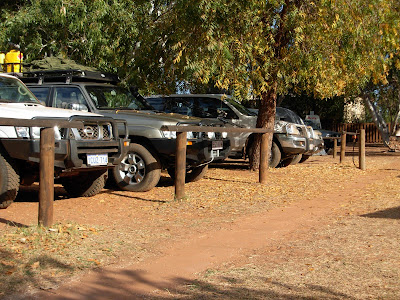
The first place I stopped on the Dampier was a sprawling tourist retreat named Kooljaman. It had been an unsuccessful and financially draining time in Broome and I figured that nothing could be less productive than another week on Cable Beach. So, after checking rental car rates (outrageous!), I booked a 4WD taxi north to arrive mid-day on Tuesday the 2nd of September. Kooljaman didn't look all that promising at first glance. It seemed to be a parking lot for expensive SUVs.


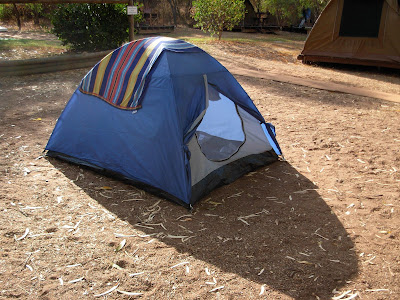
I set up my tent and started trying to book tours with some of the Bardi operators whose signs I'd seen posted at Kooljaman's main office.


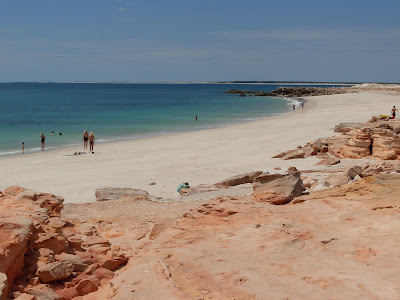
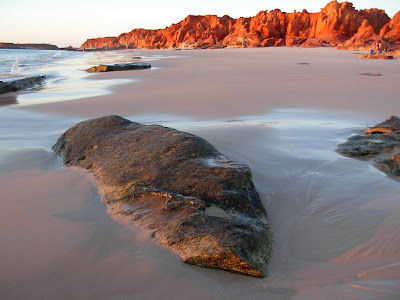
I only had to try three different operators before I got through to Annette Sampi, who runs the Sampi family tours with her partner Eddie James. I didn't have very high expectations for my tour as a means of making lasting connections, but there was always a chance. After booking with Annette, I decided to scope out the beaches of Cape Leveque. The tourist brochures rave about them and I can see why.


The next day, I took a tour with Eddie and Annette at Ngamakoon (the Sampi family outstation).

The Return

Now that I've arrived back in the US, back to a place with regular internet access, I can start posting again. I can write about my time up on the Dampier Peninsula. I can write about Ngamakoon and Djugaragyn and Djarindjin and Ardyaloon. I can write about Deb and Steve, Ngama Paul, the Sampi clan, and Kevin George. I can write about NGOs and conspiracy theories, violence and generosity, and discovery.

In reality, though, the inconsistancy of internet access was nothing more than a convenient excuse for not writing during the past month. The nature of my time in these places is the real reason why I didn't write about them weeks ago. I was far too involved in day-to-day living. Overwhelmed by it, you might say. The things I learned and the experiences I had require some processing in order to make sense of them. But, as a friend recently told me, sometimes you explain things to yourself when you explain them to others.

Monday, September 1, 2008

Departure

Hi everyone! Sorry about the lag in posts, but there really hasn't been much to write about since my arrival here. There has been a series of miscues that aren't all that much fun to write about. (Much less read about.) Fortunately, however, I'm taking a 4WD up north of Broome for at least a few days. The place is called One Arm Point / Cape Leveque / Kooljamon if you're curious. I've got a campsite reserved for 4 nights starting Tuesday the 2nd of September. Hopefully I'll meet some of the staff up there and snag an invite to one of the many communities that freckle the Dampier Peninsula. This should produce many photos, stories, and thus blog posts. It will also constitute the tail-end of my stay here in Australia as I'm running very low on $$$. So, watch for a barrage of posts in the next couple weeks (once I get back to civilization, of course).

Ted

Sunday, August 17, 2008

Broome Time

Whenever something takes longer than expected here in Broome, people always mutter the same phrase, "Broome Time." It's a little like island time in the Caribbean, except without the island part. Broome Time can be a bit frustrating at first, since everything happens a least 15 minutes after you expect it to. But once you've been here for a while it becomes normal. And who would complain when life consists of sitting around on the beach all day and having a few drinks each night? Really, nothing here in Broome is so important that it needs to get done on time.


Something I did on Broome Time.


The group that I've been bumming around with.


The downtown lunch-hour rush this Friday.

Wednesday, August 13, 2008

Broomie Broome Broome (1st Oz Post)

As the title implies, I've just arrived in Broome. Well, that's not entirely accurate. I actually arrived here two days ago, but it feels like I've only just arrived thanks to jetlag, a missing bag, and a phone that refused to work. I sorted those small blips out yesterday, though, thank god, and had enough time left over to wander around the city taking in the sites, buying necessities, and stopping off at the Broome Diocese to try and weasel my way into an aboriginal community via religion. (How unethical!) Turns out that the beach here isn't too bad here either.

(Click on the thumbs to enlarge)


Yeah, most of Broome's pretty small. This includes it's airport.


The short, 4+ mile walk to town looks like this.


Don't know what kind of trees these are, but they grow all over the place here.


The prison's covered with aboriginal art so that the disproportionate numbers of aborignal folks locked up in there will feel right at home. (Gross.)


Cable Beach (the Broome city beach) has pretty sand dunes and pretty sunsets.


See what I mean?

Wednesday, August 6, 2008

Right Across the Middle

Finally arrived in the Chicagoland area after 20+ hours of driving. Everything went smoothly, although my thermarest has finally sprung a leak after nearly four years of heavy use. Discovered that fact at a rest stop in western Iowa around 12:30 this
morning.

The scenery was fantastic at first.


Things get rather monotonous once through Vedauwoo, WY.(That's not entirely true. There are sandhills in western Nebraska, but they're not exactly dramatic.)


Regardless, it's always fun to drive across the country and see the wild parts of America. I even managed to spot a few pronghorn just outside of Laramie - wouldn't have been a roadtrip without them. It seems to me that each state has a distinct character coming both from the landscape and the driving habits of its residents. Changes happen gradually as you drive, but the bleeding together of landscapes and people across boundaries doesn't change the fact that each state has its own combination of characters. It feels good to be back in the eastern plains!

Sunday, July 27, 2008

The Next Pitch

I've heard a lot from friends, climbing heroes, and media outlets about how music can influence athletic performance, but for the last few years I've been opposed to using portable music as a supplement. I thought it introduced an ineffective, artificial means of overcoming adversity. When I push into my aerobic threshold, for example, all I can think about is pain. I've tried watching TV at the gym to distract myself and I always loose track of the Real World or The Biggest Blunders in History right when I need the frivolity the most.

But I'm starting to think that I haven't been using portable media correctly. Maybe it should be seen as something other than a distraction. It's not that I suddenly realized that all those idiots with i-pods must be onto something and I should give music a second chance. Instead, my change of heart stems from a much less cerebral series of events. Mom gave me an mp3 player as a birthday gift (against my wishes) and I began bringing this gift places - most recently to the local crag.

Robert and I had run through six pitches of moderately difficult sport climbing that left me a little worn out, both mentally and physically. I wanted to get back to the car and hang out with my girlfriend. He suggested that we go climb two more pitches.

I agreed to check them out, even though they were at my lead limit and I felt sluggish, disinterested, and a little bullied. When we arrived at the base, I popped in my earphones and picked out a track by Slayer. While Robert flitted about unpacking the rope, nibbling food, and getting the GPS coordinates for the cliff, I racked my quick draws and mouthed the lyrics I'd heard so many times. The intensity of the music helped me focus my thoughts. For me, success and failure on climbs at my limit are nearly always determined by my mental state. The best mental state for me is one of emotional intensity and total commitment. It's a state free from the clutter of unnecessary thought. That's where Slayer put me.

Once I was on belay, I took the headphones out and chalked up - no distractions. I climbed without pause. The overhanging section felt strenuous but unintimidating. A few moves through the crux were tenuous, but it still felt like the easiest pitch I'd led at the grade. My forearms were worked by the time Robert lowered me from the top. You couldn't have guessed it by how enthused I was. All I wanted was to get on the next pitch.

Wednesday, July 23, 2008

North Cascades

Jesse and I took a couple rest days after Rainier to recover and work on our rock climbing. Both of us are reasonably proficient, but climbing well as a team is key to success in the alpine and proficiency does not necessarily equate to good teamwork. We headed up to Index where Jesse led his first pitch of 5.10-. More importantly, we climbed well together after a long hiatus. Things were looking great.

We'd planned on climbing three long, committing alpine routes in the Enchantments. This area of the Cascades is popular and crowded all summer due to its proximity to Seattle and the relatively good weather. Jim Nelson, a friend of Jesse's and the owner of Pro Mountain Sports, talked us out of our objectives. He instead suggested something in the North Cascades National Park -- the Torment-Forbidden Traverse. It's typically a 2-3 day route over a couple miles of technical terrain, but Jesse and I decided to do it in a day. We felt that success was all but assured considering how well the route matched up to our strengths.

The approach went quickly as we half-hiked, half-jogged up to the base. If we could keep our pace up, we'd be off the ridge long before the sun went down.


Instead of wasting time on the South Ridge of Torment and traversing across the Southeast Face, we elected to climb the face directly. I'd read a report on it the night before and the guidebook said that the climbing was 4th class. Jesse started up across steep granite slabs in his tennies. He was ~180' up when he built our first anchor. I was confused, since we'd planned to simul-climb the entire face and stop only on the summit or to unrope. The climbing was more challenging than 4th class, however. I had to yard on gear a few times on account of my boots.

Things were not looking up when I reached Jesse's belay. He'd warned me earlier not to put unneccesary weight on the rope. As I climbed up, I realized why. All three pieces of protection were marginal. Two were plugged into cracks around a big, loose block. Another was wedged between two miniscule, unattached chunks of granite. The climbing above our belay was steep and loose.

Still, it looked like we could escape upwards if we could pull through the next ten feet.

Jesse showed me just how impossible that would be. The key moves would require pulling on a unattached block of granite that, when weighted, threatened to land on the belay. That block was the impetus for his building our crappy belay. We surveyed all possible options and arrived at the same conclusion: time to bail off of questionable protection. Then came that nastly sinking sensation in my guts.

Jesse went first with all of our gear. He had a nut holding the weight and two cams backing it up. The plan was for me to remove the back-ups if the nut looked solid on Jesse's rappel. The nut shifted.

I didn't know that sinking sensations could worsen. I thought that they were like getting kicked in the junk. I thought that as soon as the feeling had taken hold completely, things couldn't get any more intense. When the nut started popping down the slot with Jesse on rappel, I had the feeling of being on a roller coaster that had just gone over a small hump and was now diving down the big drop. I wanted to puke.

The nut re-lodged itself with one side against solid stone and the other held up by a small, artificial constriction of loose grit. Jesse completed his rappel and I decided to leave one of the cams as back up even though I couldn't move the nut from its new resting place. My trip down the rope was terrifying though uneventful. The next rappel when smoothly and soon enough we were down. Back at the base of Torment.

At first I felt grateful that things had gone as they had. After all, we'd escaped from a crappy situation with no injuries. We were alive and well, even though we'd left $110 in gear on the mountain. Then the questions started. What if we'd looked a little harder at the options above the belay? What if we had started climbing from higher up on the snowfield? Why hadn't we done what Jim recommended and climbed the South Ridge instead of the SE Face?

I didn't understand how Dad could appear so peaceful after failing on Rainier. He'd chosen to turn around due only to his fear. Jesse and I were faced with insurmountable, life-threatening obstacles and still, less than 20 minutes later, I felt disappointed and hollow. Our decision seemed questionable. We should not have failed, but we did. Was it really due to insurmountable obstacles or did I share more in common with Dad than I first thought? Had we simply given in to the Fear?

Tuesday, July 22, 2008

Rainier

I recently got back from a climbing trip to the Pacific Northwest that was full of everything I love about climbing: pain, perseverance, success, and failure.

After the long drive from Salt Lake, I met up with Dad, Kris and Jesse in Mt. Rainier National Park. We planned on climbing the mountain via a technically moderate, but long and strenuous route up the Emmons Glacier -- the longest stream of ice in the lower 48. Three of the four of us had already been on the mountain. Two of the team had high-altitude experience in other countries. We'd all been planning our ascent since spring. I was stoked on how together things seemed.

The approach went smoothly and we hit our 9600' basecamp at mid-afternoon. The next day we rested, brewed up, and did a little rescue practice. Many interesting tales were told. Most involved SE Asia. Almost all involved sex. After Jesse, Kris and I had finished brewing the last liters of water at the end of the day, I crawled back into the tent for the second night on the mountain when Dad let me in on a little secret -- he wasn't planning on leaving for the summit the next morning. He complained of an upset stomach. He complained that he felt sluggish. He complained that it was too risky.

He was scared. Starting at seracs and crevasses all day had shaken him.

Everyone who chases the dragon of risk knows Fear. The frustrating part about Fear is how subjective it can be. What seemed a mellow, grade 2 glacier route to me racked my Dad with doubt. It forced him to examine his life, his priorities, and his motivation. It magnified the hazards of glacier travel until they seemed insurmountable. Rock climbers call it getting "gripped." It's that moment when you feel too scared to move up, down, or sideways. It's that moment when palms sweat and time stops and experienced dragon chasers start talking to themselves out loud or singing their favorite pop song. ("Goodbye Yellow Brick Road" by Elton John is my personal favorite.)

We agreed to discuss things again when the alarm went off, but I knew he'd already decided. I guess sometimes it takes months of planning, roundtrip airfare, and a healthy dose of suffering to know where your boundaries are.

When the alarm went off, Dad rolled over and let me know when I already knew -- he was bailing. I was so angry that I refused to carry a flag to the summit for him. All I could think of was how great it would've been to give him a hug and tell him how proud I was that he'd summitted after two consecutive failures. I was disappointed. It felt like I'd failed even though Kris, Jesse, and I were the first to arrive at the summit that morning.

Still, the sunrise was spectacular. The intervening ridges were highlighted pink and the Enchantment Range - where Jesse and I planned on climbing in a few days - was silhouetted black against the pale sky. I remember mumbling, "this is the most beautiful thing I've ever seen" into the whipping wind. I forgot the flag and the failure and felt lucky. Looking back on the Emmons, I'm still not quite sure how I feel about it. The trip that Jesse and I took a few days later to the North Cascades clouded things a little for me.