The day after we finished the compost toilet's footings, Steve and I drove up to Djarindjin. Unlike Djugarargyn and Ngamakoon, which are called "outstations" or "blocks," Djarindjin is a "community." This means that people other than extended family members live in the same area. There is a council. There are ~300 citizens. There are also many more unseemly social issues.
It was in Djarindjin that I first met Trevor Sampi, Kevin George, and his son Dwayne. Steve had invited them over for lunch and suggested that I might like to hang out with them for a while. Once they'd finished lunch and a short interrogation of my intentions as a researcher, they invited me to ride along in their truck as a temporary member of the Bardi-Jawi Rangers. The Indigenous Rangers Program is funded by the federal government with the intentions of a) providing economic opportunities for young Aboriginal Australians who make the effort to stay in their home communities and b) encouraging active oversight of the harvest and use of resources on land held by the community.
To this end, we drove out to a few isolated blocks, checking up on residents, letting them know what was going on throughout the Dampier, asking what was going on there with the flora and fauna, and generally "looking out for country." Kevin George, the head ranger, repeatedly stated that this was the program's real utility. Since no one else could travel so widely and freely across the landscape, the rangers felt a certain level of responsibility for the entirety of Bardi and Jawi traditional lands.
I also met Mark Shadforth on this trip. Mark proved to be an uncompromisingly honest, open, and eager resource when it came to recounting the thoughts young men have about either staying home or making money somewhere else. But these conversations were still in the future. As was my second visit up to Ngamakoon. After we returned to Djarindjin, Trevor invited me to meet his father, Uncle Paul...
Saturday, October 4, 2008

More Djugarargyn
Deb arrived at Djugarargyn later that day. She'd just gotten back from a trip down to Perth where their daughter had received medical treatment. Deb and I got on just as readily as Steve and I had. I looked forward to following along on the bushwalks scheduled for Sunday and Monday.
Sure enough, Deb's knowledge of the local flora and fauna was impressive. She pointed out a number of important plants, including the Pandanus tree:
She also introduced me to the Bardi calendar. The calendar is an important set of guidelines that helps Bardi determine when to harvest which resources. The longer I stayed on the Dampier, the larger and more inclusive the calendar became. Deb wove different threads into her bush walks. The second seemed to build upon the first. If she'd scheduled more, I definitely would have kept tagging along!
Instead, she returned to Perth and I ended up helping Steve around the "block." We undertook a number of projects during my time at Djugarargyn, including: digging and cementing footings for the bio-friendly composting toilet, rerouting some kitchen plumbing, converting waste vegetable oil to biodiesel, and recycling parts from two old box trailers to make a new one.
In between our projects, we took trips to Lombadina, Djarindjin, and Ngamakoon.
Sure enough, Deb's knowledge of the local flora and fauna was impressive. She pointed out a number of important plants, including the Pandanus tree:
 |
| From Oz Fieldtrip 2008 |
She also introduced me to the Bardi calendar. The calendar is an important set of guidelines that helps Bardi determine when to harvest which resources. The longer I stayed on the Dampier, the larger and more inclusive the calendar became. Deb wove different threads into her bush walks. The second seemed to build upon the first. If she'd scheduled more, I definitely would have kept tagging along!
Instead, she returned to Perth and I ended up helping Steve around the "block." We undertook a number of projects during my time at Djugarargyn, including: digging and cementing footings for the bio-friendly composting toilet, rerouting some kitchen plumbing, converting waste vegetable oil to biodiesel, and recycling parts from two old box trailers to make a new one.
 |
| From Oz Fieldtrip 2008 |
In between our projects, we took trips to Lombadina, Djarindjin, and Ngamakoon.
Thursday, October 2, 2008
Djugarargyn
The days following Ngamakoon were possibly the most frustrating of the entire trip. I spent large chunks of time on the beach recovering from an illness that manifested itself just as I arrived at Kooljaman. It seemed like Broome north. In addition, I was vainly trying to set up a fishing trip with Eddie and his uncle Bruce, while calling Steve Nicholls every day in an effort to get in touch with the Djugarargyn mob (of which he was the male half) who had originally agreed to host me. I spent two long days in limbo.
On the fifth, I went to the office to see if I had any messages (Eddie? Steve?) as I'd done every morning since Ngamakoon. Steve had called and said he'd be around. I rang him and we both commented on how unfortunate it was that I didn't have my own truck and he was fresh out of fuel. When we hung up, it looked like I'd be going home without meeting Steve or Deb. Later, as I was walking down to the beach for the sunset, a guy from Melbourne who I'd spoken to briefly a couple days earlier offered to give me a ride back to Broome. It would be one day earlier than I planned on leaving, but I'd save $100. I told him I'd have to think about it.
I called Steve after the sunset. He agreed to host me. Gary agreed to drop me off at Djugaragyn the next morning. It was all set and I couldn't believe it. After more than 3 weeks of tedium, I was finally going to get a chance to make inroads!
I could barely contain my excitement as Gary, his wife Angie, and I trounced along the road to Djugarargyn. A shirtless Steve Nicholls greeted us at the truck. I knew things were going to go very smoothly. Steve had a relaxed sense of humor and a friendly disposition. He showed me around Djugaragyn after Gary and Angie pulled away.
First, the kitchen and front yard.
Next, the black cockatoos.
Finally, the country.
On the fifth, I went to the office to see if I had any messages (Eddie? Steve?) as I'd done every morning since Ngamakoon. Steve had called and said he'd be around. I rang him and we both commented on how unfortunate it was that I didn't have my own truck and he was fresh out of fuel. When we hung up, it looked like I'd be going home without meeting Steve or Deb. Later, as I was walking down to the beach for the sunset, a guy from Melbourne who I'd spoken to briefly a couple days earlier offered to give me a ride back to Broome. It would be one day earlier than I planned on leaving, but I'd save $100. I told him I'd have to think about it.
 |
| From Oz Fieldtrip 2008 |
I called Steve after the sunset. He agreed to host me. Gary agreed to drop me off at Djugaragyn the next morning. It was all set and I couldn't believe it. After more than 3 weeks of tedium, I was finally going to get a chance to make inroads!
I could barely contain my excitement as Gary, his wife Angie, and I trounced along the road to Djugarargyn. A shirtless Steve Nicholls greeted us at the truck. I knew things were going to go very smoothly. Steve had a relaxed sense of humor and a friendly disposition. He showed me around Djugaragyn after Gary and Angie pulled away.
First, the kitchen and front yard.
 |
| From Oz Fieldtrip 2008 |
Next, the black cockatoos.
 |
| From Oz Fieldtrip 2008 |
Finally, the country.
 |
| From Oz Fieldtrip 2008 |
 |
| From Oz Fieldtrip 2008 |
Tuesday, September 30, 2008
Ngamakoon
Eddie picked me up at Kooljaman around 8am on Wednesday, the 3rd. Eddie James is large man and more than a little imposing. In contrast to his physical presence and like nearly every Bardi man I met on my trip, Eddie proved very accommodating and patient. Gentle even.
After a jouncing trip over the pindan, we arrived at Ngamakoon where a small family from New Zealand was waiting. Annette, Eddie, the four Kiwis, Eddie's nephew Waylan and I hopped into an SUV and tooled off in the direction of the mud flat where we hoped to find a crab or two. The sucking mud felt good on my bare feet, but the mangrove roots didn't! There were schools of mud-skippers on the flate and small fish circled our ankles in the brackish pools. Crabs were more elusive.
Soon enough though, we came to a sharply cut bank on the edge of a mangrove stand. There were large holes in the mud where, according to Eddie, the mud crabs come to mate. Soon enough, Eddie started pushing a long steel rod into the holes. The rod had been bent into a hook on both ends. The idea is to stick the rod in, get a crab to clamp a claw onto it, then pull the crab out by its claw. Sometimes the crabs drop their claws in an effort to escape (claws are their heaviest bodyparts and slow the creatures down ). This is when the hooked ends of the rod come in handy. If the crab "lets go" by losing its claw, you just slide the rod back in the hole and use it like a grappling hook to pull them out by the body or leg or whatever you can get ahold of.
Luckily, the one that Eddie coaxed into clamping down on the rod didn't let go. He held on tight as Eddie dragged him from the muddy bank. What an ugly critter!
Eddie immobilized the claws by wedging them closed with a few sections of the crab's lower legs.
After the crab was safely immobilized and in a bucket, we drove down to the estuarine inlet as the tide started to rise. Eddie put on the first demonstration of spear fishing that I witnessed during my trip. Even though he didn't manage to hit anything, I was mightily impressed by the whole endeavour. More on that later...
After a jouncing trip over the pindan, we arrived at Ngamakoon where a small family from New Zealand was waiting. Annette, Eddie, the four Kiwis, Eddie's nephew Waylan and I hopped into an SUV and tooled off in the direction of the mud flat where we hoped to find a crab or two. The sucking mud felt good on my bare feet, but the mangrove roots didn't! There were schools of mud-skippers on the flate and small fish circled our ankles in the brackish pools. Crabs were more elusive.
Soon enough though, we came to a sharply cut bank on the edge of a mangrove stand. There were large holes in the mud where, according to Eddie, the mud crabs come to mate. Soon enough, Eddie started pushing a long steel rod into the holes. The rod had been bent into a hook on both ends. The idea is to stick the rod in, get a crab to clamp a claw onto it, then pull the crab out by its claw. Sometimes the crabs drop their claws in an effort to escape (claws are their heaviest bodyparts and slow the creatures down ). This is when the hooked ends of the rod come in handy. If the crab "lets go" by losing its claw, you just slide the rod back in the hole and use it like a grappling hook to pull them out by the body or leg or whatever you can get ahold of.
Luckily, the one that Eddie coaxed into clamping down on the rod didn't let go. He held on tight as Eddie dragged him from the muddy bank. What an ugly critter!
 |
| From Oz Fieldtrip 2008 |
Eddie immobilized the claws by wedging them closed with a few sections of the crab's lower legs.
 |
| From Oz Fieldtrip 2008 |
After the crab was safely immobilized and in a bucket, we drove down to the estuarine inlet as the tide started to rise. Eddie put on the first demonstration of spear fishing that I witnessed during my trip. Even though he didn't manage to hit anything, I was mightily impressed by the whole endeavour. More on that later...
Monday, September 29, 2008
Kooljaman
I've decided to write about the Dampier as a series of places. The Bardi people who call this part of the world home define themselves in terms of country. Often the first question I was asked after being introduced to a new person was not, "What do you do?" But rather, "Where are you from?" My hosts assured me that this was not just an effect of my American accent.
The first place I stopped on the Dampier was a sprawling tourist retreat named Kooljaman. It had been an unsuccessful and financially draining time in Broome and I figured that nothing could be less productive than another week on Cable Beach. So, after checking rental car rates (outrageous!), I booked a 4WD taxi north to arrive mid-day on Tuesday the 2nd of September. Kooljaman didn't look all that promising at first glance. It seemed to be a parking lot for expensive SUVs.
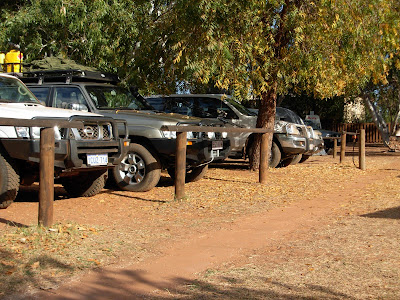
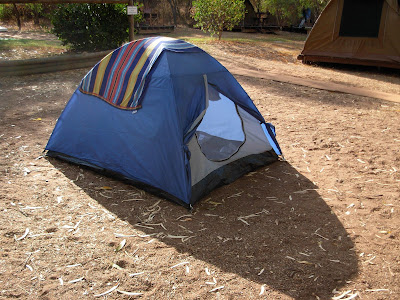
I set up my tent and started trying to book tours with some of the Bardi operators whose signs I'd seen posted at Kooljaman's main office.
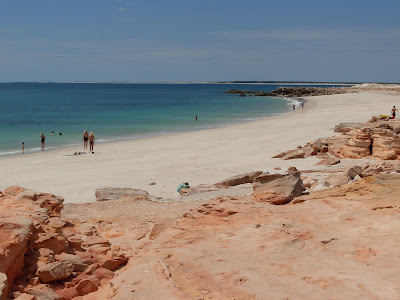
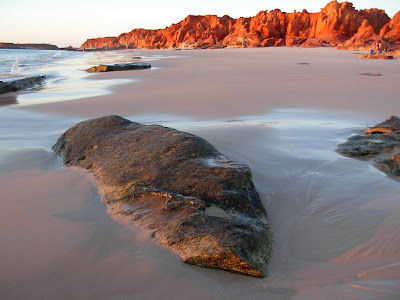
I only had to try three different operators before I got through to Annette Sampi, who runs the Sampi family tours with her partner Eddie James. I didn't have very high expectations for my tour as a means of making lasting connections, but there was always a chance. After booking with Annette, I decided to scope out the beaches of Cape Leveque. The tourist brochures rave about them and I can see why.
The next day, I took a tour with Eddie and Annette at Ngamakoon (the Sampi family outstation).
The first place I stopped on the Dampier was a sprawling tourist retreat named Kooljaman. It had been an unsuccessful and financially draining time in Broome and I figured that nothing could be less productive than another week on Cable Beach. So, after checking rental car rates (outrageous!), I booked a 4WD taxi north to arrive mid-day on Tuesday the 2nd of September. Kooljaman didn't look all that promising at first glance. It seemed to be a parking lot for expensive SUVs.
I set up my tent and started trying to book tours with some of the Bardi operators whose signs I'd seen posted at Kooljaman's main office.
I only had to try three different operators before I got through to Annette Sampi, who runs the Sampi family tours with her partner Eddie James. I didn't have very high expectations for my tour as a means of making lasting connections, but there was always a chance. After booking with Annette, I decided to scope out the beaches of Cape Leveque. The tourist brochures rave about them and I can see why.
The next day, I took a tour with Eddie and Annette at Ngamakoon (the Sampi family outstation).
The Return
Now that I've arrived back in the US, back to a place with regular internet access, I can start posting again. I can write about my time up on the Dampier Peninsula. I can write about Ngamakoon and Djugaragyn and Djarindjin and Ardyaloon. I can write about Deb and Steve, Ngama Paul, the Sampi clan, and Kevin George. I can write about NGOs and conspiracy theories, violence and generosity, and discovery.
In reality, though, the inconsistancy of internet access was nothing more than a convenient excuse for not writing during the past month. The nature of my time in these places is the real reason why I didn't write about them weeks ago. I was far too involved in day-to-day living. Overwhelmed by it, you might say. The things I learned and the experiences I had require some processing in order to make sense of them. But, as a friend recently told me, sometimes you explain things to yourself when you explain them to others.
In reality, though, the inconsistancy of internet access was nothing more than a convenient excuse for not writing during the past month. The nature of my time in these places is the real reason why I didn't write about them weeks ago. I was far too involved in day-to-day living. Overwhelmed by it, you might say. The things I learned and the experiences I had require some processing in order to make sense of them. But, as a friend recently told me, sometimes you explain things to yourself when you explain them to others.
Subscribe to:
Comments (Atom)